 Import Data Templates
Imports
Import customers into Business Central from Excel or CSV
CRM exports and customer lists, turned into customer cards with their addresses and related records.
Customer data also arrives as files: a CRM export, the customers of a webshop, a list prepared by sales for a new market. Creating them by hand means the customer card and then the related pages, ship-to addresses, bank accounts, dimensions, one customer at a time.
With Import Data Templates, one row of the file creates or updates the customer together with what belongs to it: a ship-to address in the shipped example, bank accounts, default dimensions. Matched by the customer number, the same file can be imported again to update what changed.
What the file can look like
One row per customer, with the columns the source provides: number, name, address, contact data, posting groups and payment terms where the source knows them, and the related data next to them. Values the file does not carry are set as default values in the template or asked when the import starts. With write mode Insert or Update, rows for existing customers update them instead of failing; rows without a number are created and numbered by the number series.
Sample file: EX-CUSTOMERS.csv
- Sample file: EX-CUSTOMERS.csv
How the import works
-
Load the template
Create
EX-CUSTOMERSfrom the Template Examples page, or describe your export in a template of your own: fill it in from the structure of the file, use Read Structure from File, or let Copilot propose it from a sample and review it before keeping it. Related records, the ship-to address in the example, are added to the template with Add Related Record.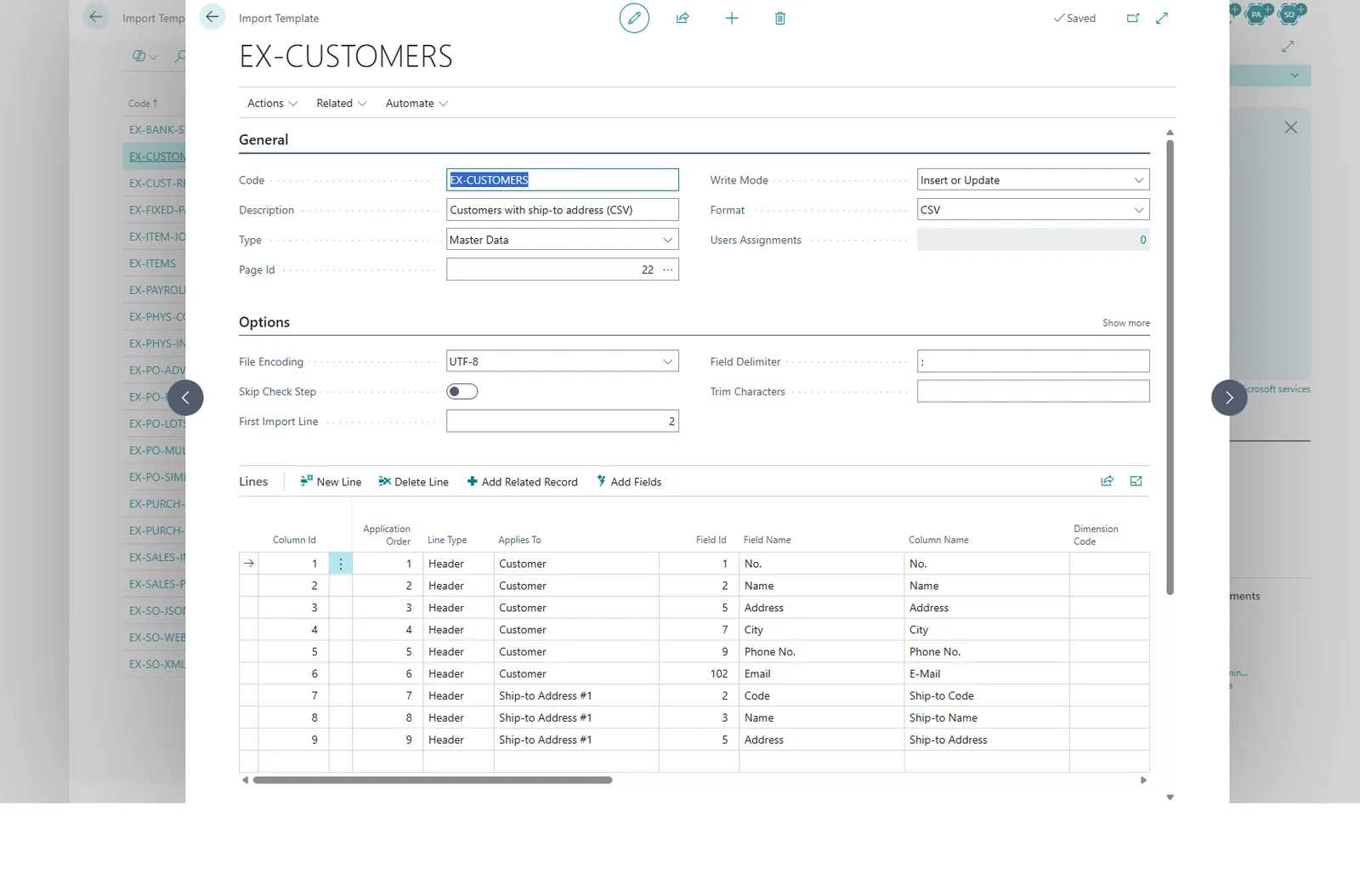
The EX-CUSTOMERS template: write mode Insert or Update, CSV with semicolons, the customer fields and the ship-to address on the same row. -
Start the import from the Customers list
Choose Import Template on the Customers list, pick the template and the file, and answer the import parameters if the template asks any. The check step validates every value and the write mode rules, and reports each problem with the line of the file.
The flow: Import Template on the Customers list, the template and the file, the result. -
The customers are ready
The customers exist with their ship-to addresses and related records, ready for orders and invoices. The import history records the file and the result; importing the same file again later updates the customers it matches.
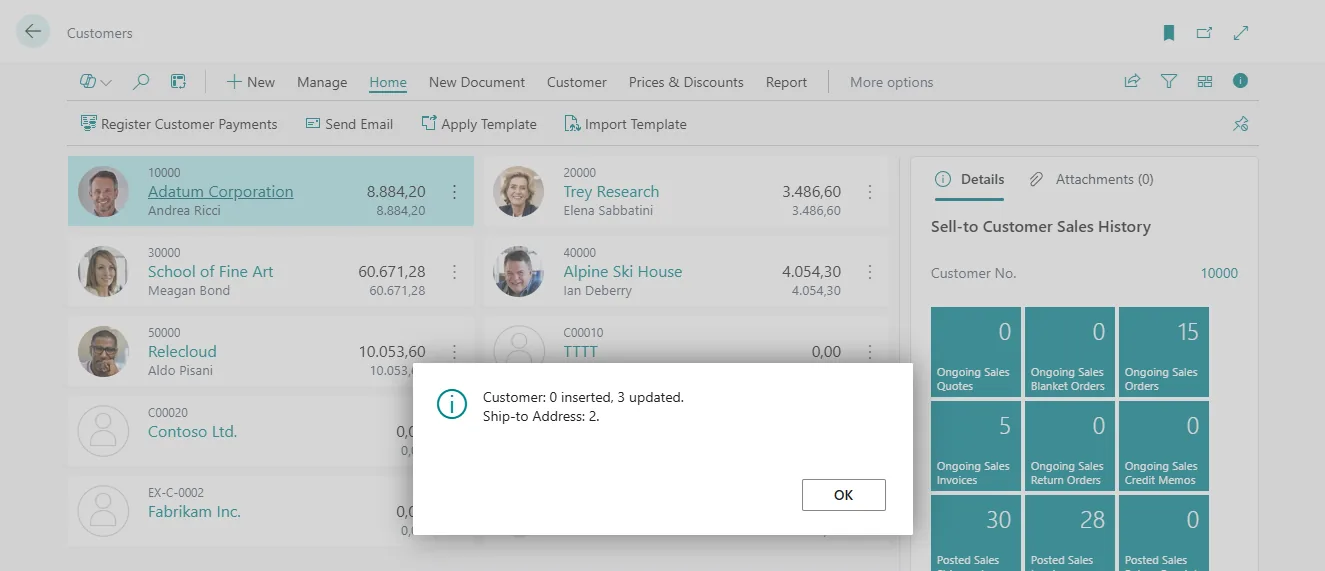
The result of a second import of the same file: no customer inserted, three updated, two ship-to addresses written.
Beyond the basic file
- More related records on the same row: customer bank accounts and default dimensions, configured like the ship-to address; a row whose related columns are empty simply skips them.
- Several ship-to addresses for one customer: repeat the customer row with a different address code, or configure a second address group in the template.
- Codes that differ between the source and Business Central, such as countries, payment terms or salespeople: mapping rules translate them during the import.
- Vendors import the same way from the Vendors list, with bank accounts on the row; see vendors.
- A CRM that exports on a schedule: the automatic imports watch the folder it writes to.
Questions
Can the same file both create and update customers?
Yes, with write mode Insert or Update: rows are matched by the customer number, existing customers are updated, new ones created.
What about customers without a number in the file?
They are created and the number series assigns the numbers. Updating them later needs a file that carries the assigned numbers.
Does the import create setup data such as posting groups?
No. Posting groups, payment terms and similar setup must exist; the import assigns them to the customer and reports the rows whose codes do not exist.
Import Data Templates is available on Microsoft AppSource with a one-month free trial. Licenses are assigned per user in the Microsoft 365 admin center.